Capital Insights: 3 Financial Planning Questions for Higher Gas Prices
May 20 2026 | Back to Blog List
VIDEO TRANSCRIPT:
Hi, I’m Trent Von Ahsen, partner with Cedar Point Capital Partners. Welcome to the May 2026 edition of Capital Insights.
This month, we’re stepping slightly outside our usual format to focus on the planning decisions that matter right now.
If you’ve filled up your tank lately, you’ve felt it—gas prices have climbed sharply this spring amid renewed supply disruptions in the Middle East. Rather than trying to predict where prices will go next, we think a more useful approach is to ask three planning questions that actually lead somewhere.
First—where is the cost increase being absorbed in your budget?
For example, in a household with two cars, fuel costs may be up $1,200 to $1,800 per year compared to just a few months ago. That increase must come from somewhere—usually from savings or an investment portfolio.
The key question is whether that shift is happening intentionally…or just by default.
Second—does a stretch of higher inflation change your long-term plan?
Now, in most cases, it doesn’t. Long-term plans are built around decades of data, not a single year’s spike. A temporary stretch of elevated inflation typically doesn’t move the needle much.
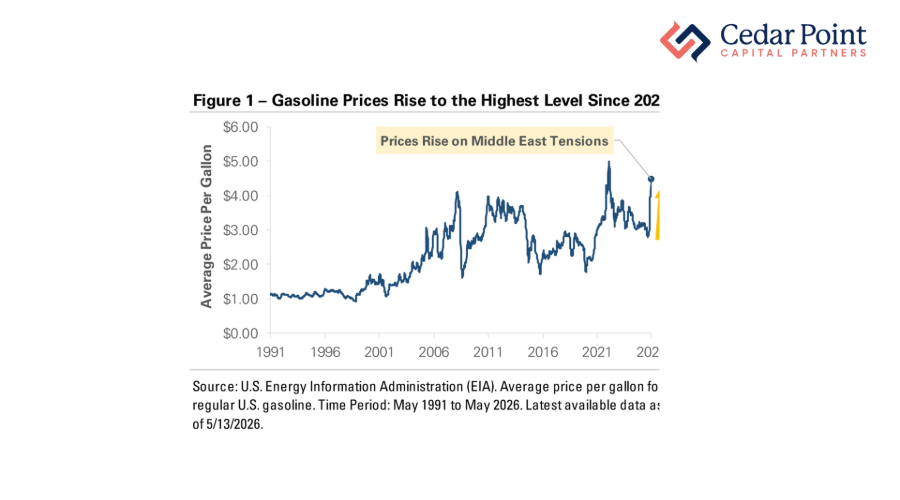
Here, Figure 1 helps put this in perspective. Oil spikes like this have happened before, often during periods of geopolitical tension—and they’ve historically been followed by periods of easing. Well-constructed financial plans are designed to absorb stretches like this.
Third—for those already in retirement, is your income plan still comfortably covering your spending?
Higher fuel and grocery costs are usually within the margin a retirement plan is built to handle—but it’s worth confirming. Compare recent spending to what your plan projected. Is the gap narrowing or widening? Catching that early helps keep any adjustments small.
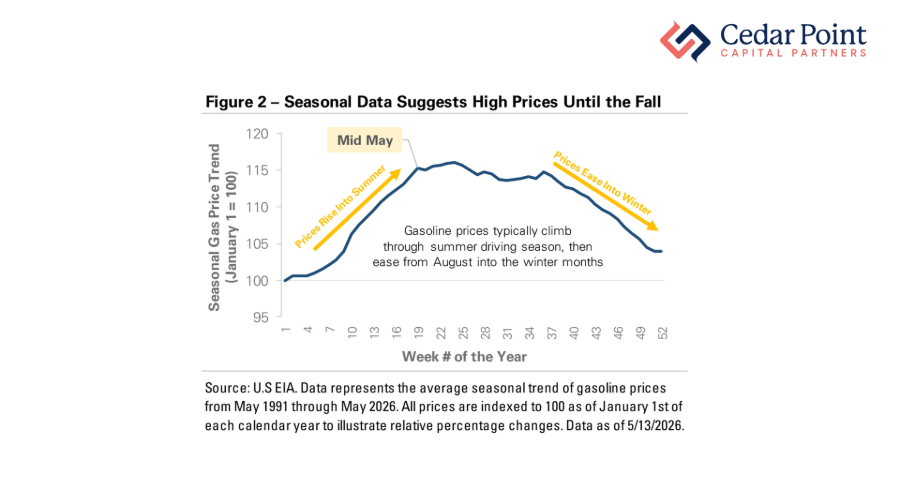
We see that Figure 2 adds another useful layer. Gas prices tend to peak around mid-May—right where we are now—and ease into the fall and winter. That pattern isn’t guaranteed this year, but it does suggest the possibility of some seasonal relief ahead.
These are exactly the kinds of questions a regular planning review is meant to answer. If any of them feel relevant to your situation, please reach out, and let’s start the conversation.
My name is Trent Von Ahsen, and I look forward to seeing you right here next month for our latest edition of Capital Insights.
Stay curious, stay mindful of your goals, and we’ll see you next time.
The commentary on this blog reflects the personal opinions, viewpoints, and analyses of Cedar Point Capital Partners (CPCP) employees providing such comments and should not be regarded as a description of advisory services provided by CPCP or performance returns of any CPCP client. The views reflected in the commentary are subject to change at any time without notice. Nothing on this blog constitutes investment advice, performance data or any recommendation that any particular security, portfolio of securities, transaction, or investment strategy is suitable for any specific person. Any mention of a particular security and related performance data is not a recommendation to buy or sell that security. Cedar Point Capital Partners manages its clients’ accounts using a variety of investment techniques and strategies, which are not necessarily discussed in the commentary. Investments in securities involve the risk of loss. Past performance is no guarantee of future results.