Capital Insights: Bonds Are Back in the Conversation
Oct 22 2026 | Back to Blog List
VIDEO TRANSCRIPT:
Hi, I’m Trent Von Ahsen, partner with Cedar Point Capital Partners. Welcome to the October 2026 edition of Capital Insights.
This month, we’re looking at a quiet but meaningful shift in the markets: for the first time in years, bonds are offering real competition to stocks.
For a long time, investors had few places to look in the search for higher returns. After the 2008 financial crisis, the Federal Reserve held interest rates extremely low, and investment grade bonds paid very little income. Investors even coined a phrase for it: TINA, short for “There Is No Alternative.” Stocks carried more risk, but they also offered earnings growth, dividends, and higher potential returns.
Well, now that regime seems to be changing. Let’s take a look at Figure 1.
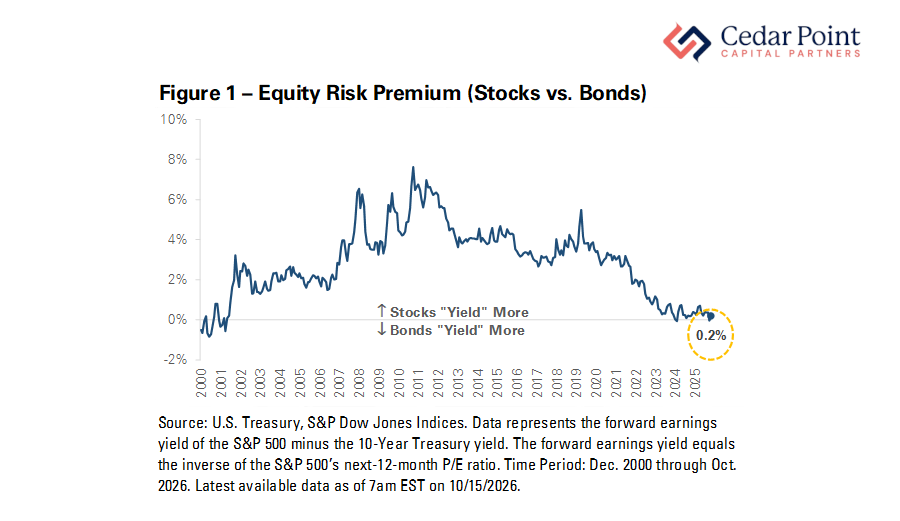
To compare equities and fixed income assets, we need a common yardstick. Stocks don’t pay a fixed rate of interest, so to put them on equal footing, we use something called the earnings yield. It shows how much profit S&P 500 constituent companies are expected to earn relative to their market value. A 5.3 percent earnings yield means we expect to see about $5.30 of earnings for every $100 of market value.
Figure 1 takes that earnings yield and subtracts the 10-year Treasury yield. When the line is above zero, stocks offer the higher yield. When it’s below zero, bonds do.
For years, the line sat well above zero, climbing above 7 percent in the early 2010s. Today, it’s down to just 0.2 percent, the smallest stock advantage in more than twenty years.
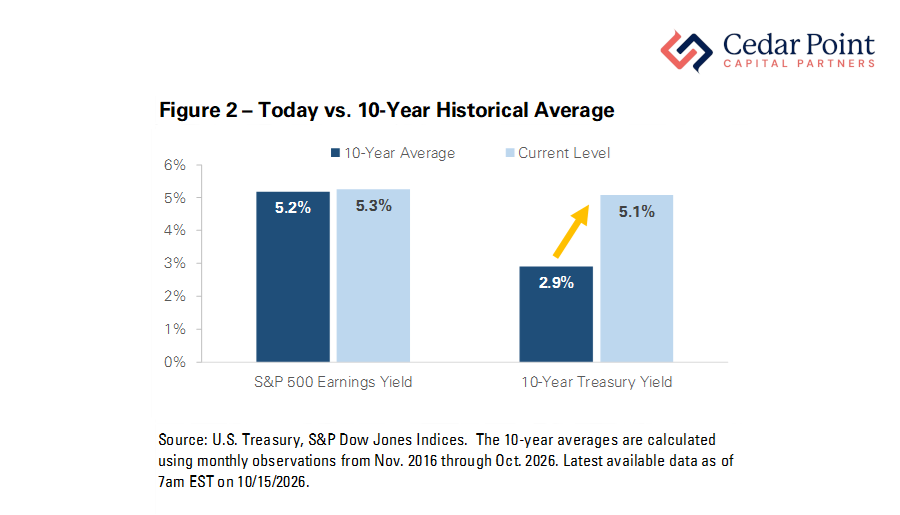
Figure 2 shows what’s driving it. The S&P 500’s earnings yield, 5.3 percent, is right in line with its 10-year average of 5.2 percent. However, as of this recording, the 10-year Treasury yield is about 5.1 percent, more than two whole points above its 10-year average of 2.9 percent.
So, the shift has come almost entirely from bonds. Yields began climbing in 2022 as the Fed raised rates to fight inflation, and they’ve stayed elevated as investors weigh persistent inflation, the possibility of further rate hikes, and large federal deficits that require the Treasury to issue more debt.
Now, this doesn’t necessarily mean bonds will outperform stocks. Higher yields come with their own risks. Bond prices fall as rates rise – as we’ve seen, and inflation can erode the purchasing power of the income bonds pay. And stocks offer something bonds can’t: the potential for earnings to grow over time.
The real takeaway is that investors have more choices than they’ve had in years. When bonds paid so little, many portfolios leaned on stocks to do the heavy lifting. Today, higher starting yields provide more flexibility to balance income, growth, and risk, and that balance is what a well-constructed portfolio is built around.
If you have any questions about this video or your portfolio, reach out and let’s start the conversation.
My name is Trent Von Ahsen, and I look forward to seeing you right here next month for our latest edition of Capital Insights.
Stay curious, stay mindful of your goals, and we’ll see you next time.
The commentary on this blog reflects the personal opinions, viewpoints, and analyses of Cedar Point Capital Partners (CPCP) employees providing such comments and should not be regarded as a description of advisory services provided by CPCP or performance returns of any CPCP client. The views reflected in the commentary are subject to change at any time without notice. Nothing on this blog constitutes investment advice, performance data or any recommendation that any particular security, portfolio of securities, transaction, or investment strategy is suitable for any specific person. Any mention of a particular security and related performance data is not a recommendation to buy or sell that security. Cedar Point Capital Partners manages its clients’ accounts using a variety of investment techniques and strategies, which are not necessarily discussed in the commentary. Investments in securities involve the risk of loss. Past performance is no guarantee of future results.