Capital Insights: Forecasts Change, Plans Shouldn't
Jul 22 2026 | Back to Blog List
VIDEO TRANSCRIPT:
Hi, I'm Trent Von Ahsen, partner with Cedar Point Capital Partners. Welcome to the July 2026 edition of Capital Insights.
This year has been a useful reminder of how quickly market forecasts can change—and why a well-built financial plan shouldn't have to.
One of the best examples of this comes from the bond market. If we look back to the start of this year, the Federal Reserve was expected to cut interest rates twice before year end. Today, that expectation has reversed to rate hikes instead.
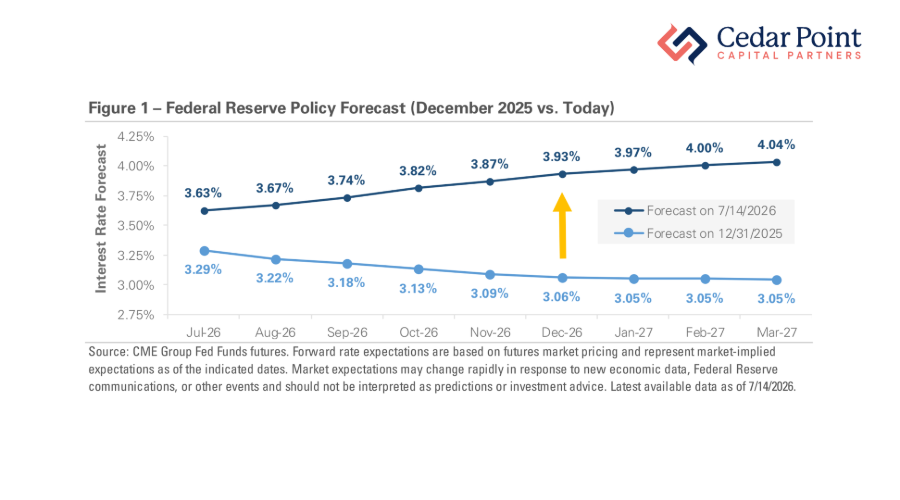
Figure 1 captures that shift. Both lines graph the market's rate forecast for the same stretch of time—from now through early 2027. The only difference here is when each forecast was made.
The lighter line is the projection made at the end of last year. The darker line is the view today. Looking at December 2026, you can see the two Federal Funds futures forecasts sit nearly a full percentage point apart.
Now, it's worth being clear about what these lines are. Neither one tracks the Fed's actual decisions. Each reflects the market's collective best guess, priced in real time and revised as new information arrives.
In January, cooling inflation and a softening job market made rate cuts look like the obvious path. Over the following months, however, the economy held up stronger than expected and rising oil prices raised new inflation concerns—so the consensus flipped toward hikes.
The takeaway here isn't really about interest rates. It's about forecasts, and how even the most confident, evidence-based ones can change, sometimes quickly.
Consider an investor who saw January's forecast and repositioned their portfolio for falling rates. Within months, they may have been leaning the wrong way, and facing a choice between doubling down or selling at a loss.
That's why we don't build your portfolio around a single forecast, however widely shared the consensus might be. Market views still matter, and they inform how portfolios are positioned—but they're only one consideration, because no one knows in advance which forecast will prove right.
The more durable approach is to diversify. A well-constructed financial plan doesn't need to know whether rates rise or fall next year—it's built for a range of outcomes and designed to hold up, whatever the environment.
If you're wondering whether your own plan and portfolio are built that way, that's exactly the kind of question a planning review is meant to answer. Reach out and let's start the conversation.
My name is Trent Von Ahsen, and I look forward to seeing you right here next month for our latest edition of Capital Insights. Stay curious, stay mindful of your goals, and we'll see you next time.
The commentary on this blog reflects the personal opinions, viewpoints, and analyses of Cedar Point Capital Partners (CPCP) employees providing such comments and should not be regarded as a description of advisory services provided by CPCP or performance returns of any CPCP client. The views reflected in the commentary are subject to change at any time without notice. Nothing on this blog constitutes investment advice, performance data or any recommendation that any particular security, portfolio of securities, transaction, or investment strategy is suitable for any specific person. Any mention of a particular security and related performance data is not a recommendation to buy or sell that security. Cedar Point Capital Partners manages its clients’ accounts using a variety of investment techniques and strategies, which are not necessarily discussed in the commentary. Investments in securities involve the risk of loss. Past performance is no guarantee of future results.