Capital Insights: When Wall Street Breaks Its Own Pattern
Aug 27 2026 | Back to Blog List
VIDEO TRANSCRIPT:
Hi, I'm Trent Von Ahsen, partner with Cedar Point Capital Partners. Welcome to the August 2026 edition of Capital Insights.
It's late August in Iowa — buses are back on the road, and out past town stands a crop nobody can quite size up until harvest. Yield estimates get revised all season long as the weather tells us more.
No, Capital Insights hasn't taken a turn toward agriculture — but stay with me.
Wall Street revises its numbers too, but almost always in one direction: analysts start optimistic about how much companies will earn, then spend the following quarters quietly walking those numbers back as results come in. This year, that pattern has flipped.
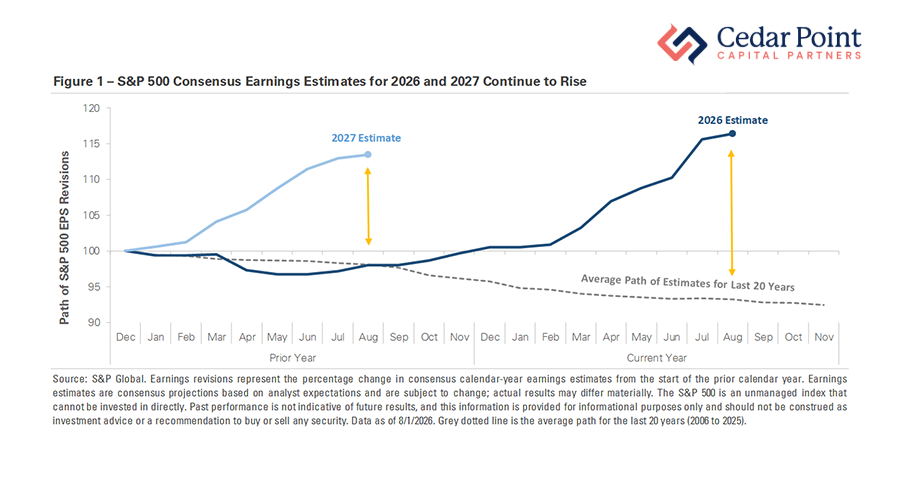
Figure 1 tracks those revisions. Each line follows the consensus estimate — that’s the average of what all the analysts covering the S&P 500 constituent companies expect it to earn in a given year. They begin forecasting a year roughly two years ahead, and each year's starting point is set to 100 so the paths can be compared.
The gray dashed line is the twenty-year average. It drifts downward and finishes about 8% below where it began — the normal pattern of optimism trimmed to match results.
Now look at the darker lines, tracking 2026 and 2027. Both are up more than 10%. And notice 2026 in particular: through that first year it followed the downward drift almost exactly. Then it turned, and it's been climbing since.
The reason is straightforward — companies have been earning more than expected. The S&P 500 is on track for its seventh consecutive quarter of double-digit earnings growth, and more than 85% of S&P 500 companies beat their second-quarter estimates, against a five-year average of 78%. Corporate spending on artificial intelligence accounts for much of that, though the strength reaches well beyond technology.
What makes it striking is the backdrop: conflict in the Middle East, volatile oil prices, and inflation that hasn't fully cooled.
Which brings me to the part that actually matters, and it isn't about earnings. It's the distance between what the headlines were saying this year and what the underlying numbers were doing. An investor who repositioned around the news cycle would have been working from a very different picture than the one in this chart.
That said, estimates are forecasts, not results — and this cycle's estimates sit unusually high. When expectations run this far above the historical path, companies have less room for error and stretches of volatility wouldn't be surprising. No one knows in advance whether this pattern holds.
Which is why we don't build plans around any single forecast, however encouraging. Over long periods, prices have tended to follow earnings rather than headlines. The more useful question isn't whether this streak continues — it's whether your plan still holds up if it doesn't.
If you have any questions about this video or your portfolio, reach out and let's start the conversation.
My name is Trent Von Ahsen, and I look forward to seeing you right here next month for our latest edition of Capital Insights.
Stay curious, stay mindful of your goals, and we'll see you next time.
The commentary on this blog reflects the personal opinions, viewpoints, and analyses of Cedar Point Capital Partners (CPCP) employees providing such comments and should not be regarded as a description of advisory services provided by CPCP or performance returns of any CPCP client. The views reflected in the commentary are subject to change at any time without notice. Nothing on this blog constitutes investment advice, performance data or any recommendation that any particular security, portfolio of securities, transaction, or investment strategy is suitable for any specific person. Any mention of a particular security and related performance data is not a recommendation to buy or sell that security. Cedar Point Capital Partners manages its clients’ accounts using a variety of investment techniques and strategies, which are not necessarily discussed in the commentary. Investments in securities involve the risk of loss. Past performance is no guarantee of future results.