Capital Insights: What History Says When the Fed Starts Raising Rates
Nov 23 2026 | Back to Blog List
VIDEO TRANSCRIPT:
Hi, I’m Trent Von Ahsen, partner with Cedar Point Capital Partners. Welcome to the November 2026 edition of Capital Insights.
This month, we’re asking a question that’s been on a lot of minds: what does history say about stocks when the Federal Reserve starts raising interest rates?
It’s a timely one. In September, the Fed raised rates for the first time since 2023. Markets now expect another increase in December, with the possibility of more in early 2027. Higher rates make borrowing more expensive for consumers and businesses, so it’s natural to wonder what that means for stocks.
History offers a more balanced answer than you might expect. Since 1990, the Fed has started six tightening cycles. Let’s see how that played out and take a look at Figure 1.
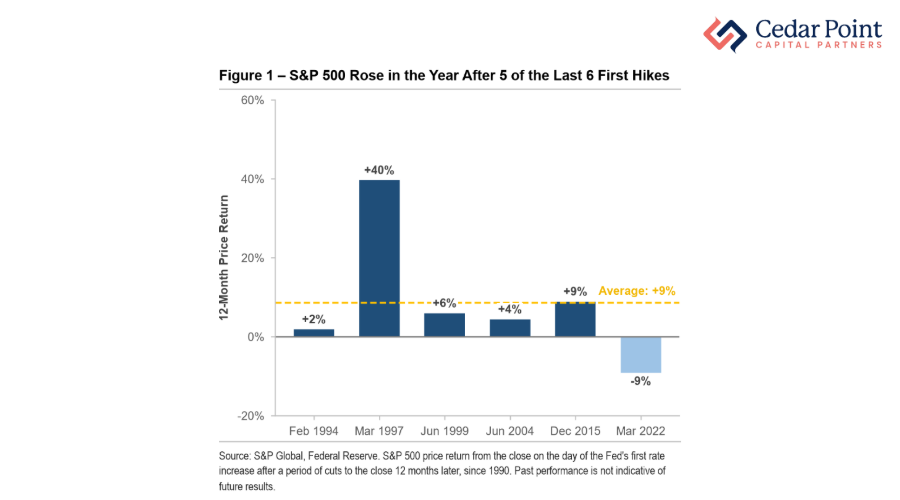
Here, we see the S&P 500 Index return over the twelve months following the initial rate hike of each cycle. In five of the six cycles, stocks were higher a year later.
At first look, the average gain has been about 9%, but that figure is influenced by a very strong 40% return in 1997. The more typical result, the median, was a more modest 5% return.
The one decline came in 2022, when the S&P 500 fell about 9%. But that cycle was a bit unusual. Post-COVID, inflation topped 8%, a four-decade high, and the Fed raised rates seven times in that year alone. In earlier cycles, the Fed started hiking with inflation around 3% or lower, and with an economy strong enough to absorb higher borrowing costs.
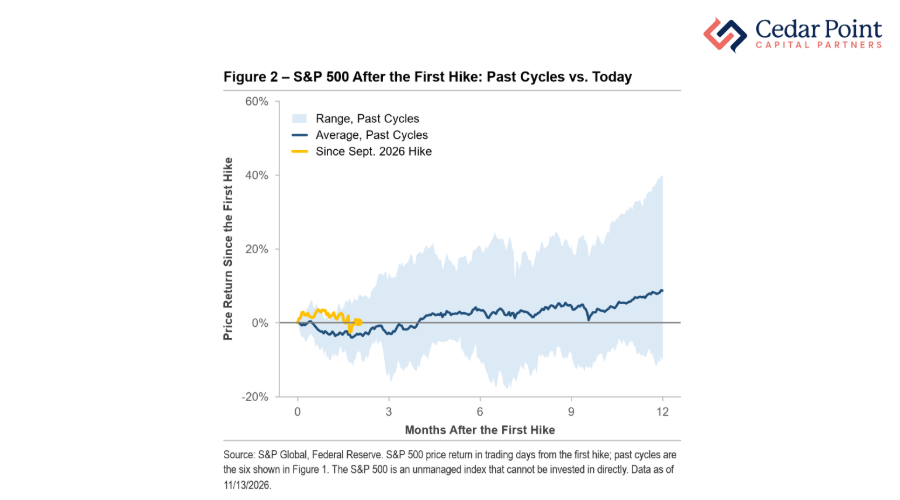
Of course, those gains didn’t arrive in a straight line. Moving to Figure 2, we can see the path stocks took along the way.
On average, the market stumbled at first, falling about 4% at its low point as investors adjusted to the idea of higher rates. It then recovered in roughly four months and moved higher over the rest of the year. But notice how wide the range of individual paths is. That’s a good reminder that averages smooth over a lot of short-term movement.
So far, this cycle has looked similar. The S&P 500 is roughly flat since the September hike, despite some volatility tied to a selloff in technology stocks.
Today’s backdrop sits somewhere between those past cycles. Inflation is near 3.7%, higher than in most earlier cycles, but far below the 2022 peak and with an economy that grew at a strong pace in the third quarter.
That matters, because the Fed typically raises rates when it sees an economy with real momentum. And that same momentum often supports corporate earnings. It’s one reason the start of a hiking cycle hasn’t usually marked the end of a rising market.
Now, six cycles is a small sample, and every cycle is different. History isn’t a guarantee. But it does suggest that higher rates alone aren’t a reason for long-term investors to change course.
As we discussed back in July, forecasts about the Fed can change quickly. That’s why we focus on what we can control: diversification, disciplined rebalancing, and a plan built to hold up across a range of outcomes, rather than a single call on interest rates.
If you have any questions about this video or your portfolio, reach out and let’s start the conversation.
My name is Trent Von Ahsen, and I look forward to seeing you right here next month for our latest edition of Capital Insights.
Stay curious, stay mindful of your goals, and we’ll see you next time.
The commentary on this blog reflects the personal opinions, viewpoints, and analyses of Cedar Point Capital Partners (CPCP) employees providing such comments and should not be regarded as a description of advisory services provided by CPCP or performance returns of any CPCP client. The views reflected in the commentary are subject to change at any time without notice. Nothing on this blog constitutes investment advice, performance data or any recommendation that any particular security, portfolio of securities, transaction, or investment strategy is suitable for any specific person. Any mention of a particular security and related performance data is not a recommendation to buy or sell that security. Cedar Point Capital Partners manages its clients’ accounts using a variety of investment techniques and strategies, which are not necessarily discussed in the commentary. Investments in securities involve the risk of loss. Past performance is no guarantee of future results.