Capital Insights: Why the Market's Worst Days Matter Most
Apr 22 2026 | Back to Blog List
VIDEO TRANSCRIPT:
Hi, I’m Trent Von Ahsen, partner with Cedar Point Capital Partners. Welcome to the April 2026 edition of Capital Insights.
Well, it’s been an interesting stretch for markets.
After a strong run to start the year, the S&P 500 Index declined nearly 10% from late January through the end of March – a reminder that even in positive long-term environments, volatility doesn’t take time off.
Moments like this give us a good opportunity to revisit a principle that’s simple, but incredibly important to long-term success:
The market’s best days often come very close to its worst.
That creates a real challenge for investors. Because when uncertainty rises – whether it’s geopolitical tension, interest rates, or something else – the instinct to step aside can feel rational in the moment.
But historically, those same environments often set the stage for recovery.
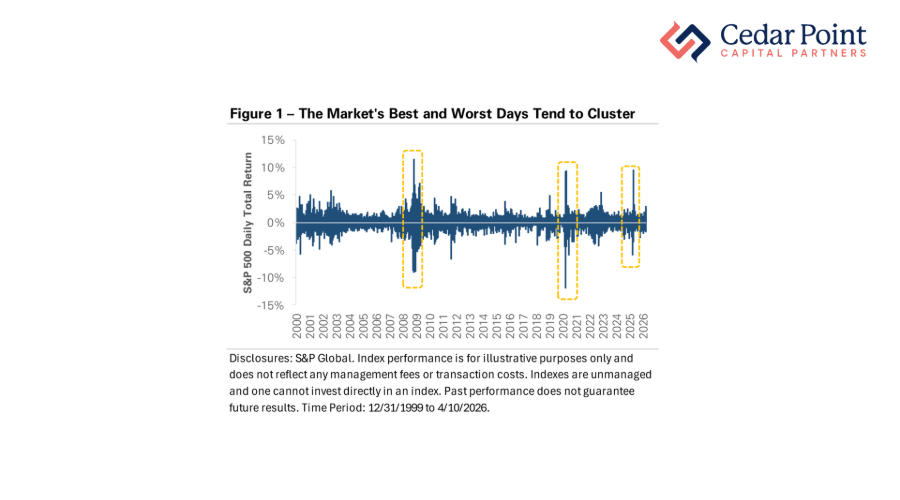
As we take a look at Figure 1, you’ll notice a consistent pattern: the markets’ largest gains and largest losses tend to cluster together. That was true during the great financial crisis, during the pandemic, and true again in recent weeks.
This leads to an important implication for investors: trying to avoid the worst days often means missing the rebounds that fuel compounding.
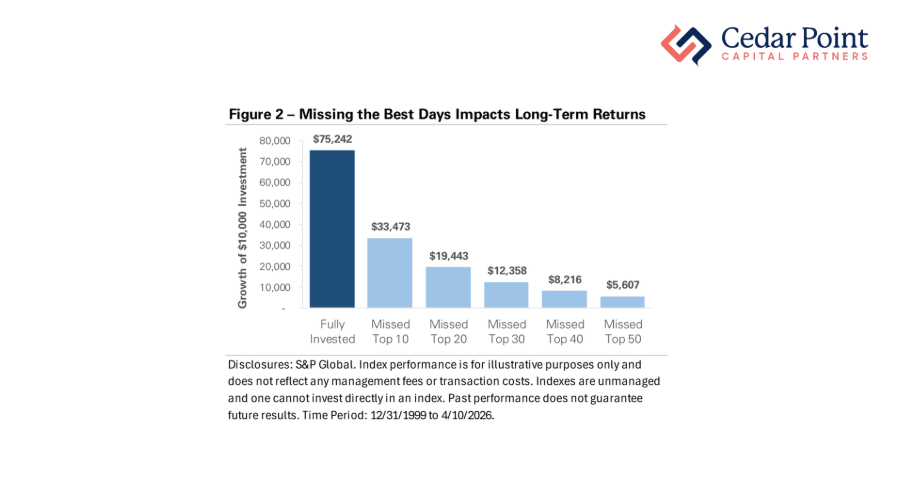
Moving to Figure 2 we can see the cost of that error can be significant.
Here, a hypothetical $10,000 investment in the S&P 500 over the past 25 years would have grown to more than $75,000 – if, you stayed fully invested throughout.
But, if you missed just the 10 best days in the market, that ending value is cut by more than half.
Miss 20 days, and it drops even further. Miss the top 40, and you actually lose money over a period when markets delivered strong long-term returns.
That’s the tradeoff. Trying to avoid short-term declines often introduces a different kind of risk: the risk of missing the recovery.
And just as importantly, it creates a difficult reentry decision. Because markets rarely send a clear signal when it’s time to get back in. This is why thoughtful investors don’t rely on prediction – they rely on preparation.
A well-constructed financial plan accounts for periods like this. Diversification helps manage uncertainty. Cash reserves provide flexibility. And disciplined rebalancing allows you to lean into volatility, rather than react to it.
Because in the end, the market doesn’t reward perfect timing. It rewards patience, discipline, and time.
For more on this, you can read our Financial Insights column on why time in the market beats timing the market out at our website, cedarpointcap.com.
If you have any questions about this video or your portfolio, reach out and let’s start the conversation.
My name is Trent Von Ahsen, and I look forward to seeing you right here next month for our latest edition of Capital Insights.
Stay curious, stay mindful of your goals, and we’ll see you next time.
The commentary on this blog reflects the personal opinions, viewpoints, and analyses of Cedar Point Capital Partners (CPCP) employees providing such comments and should not be regarded as a description of advisory services provided by CPCP or performance returns of any CPCP client. The views reflected in the commentary are subject to change at any time without notice. Nothing on this blog constitutes investment advice, performance data or any recommendation that any particular security, portfolio of securities, transaction, or investment strategy is suitable for any specific person. Any mention of a particular security and related performance data is not a recommendation to buy or sell that security. Cedar Point Capital Partners manages its clients’ accounts using a variety of investment techniques and strategies, which are not necessarily discussed in the commentary. Investments in securities involve the risk of loss. Past performance is no guarantee of future results.